
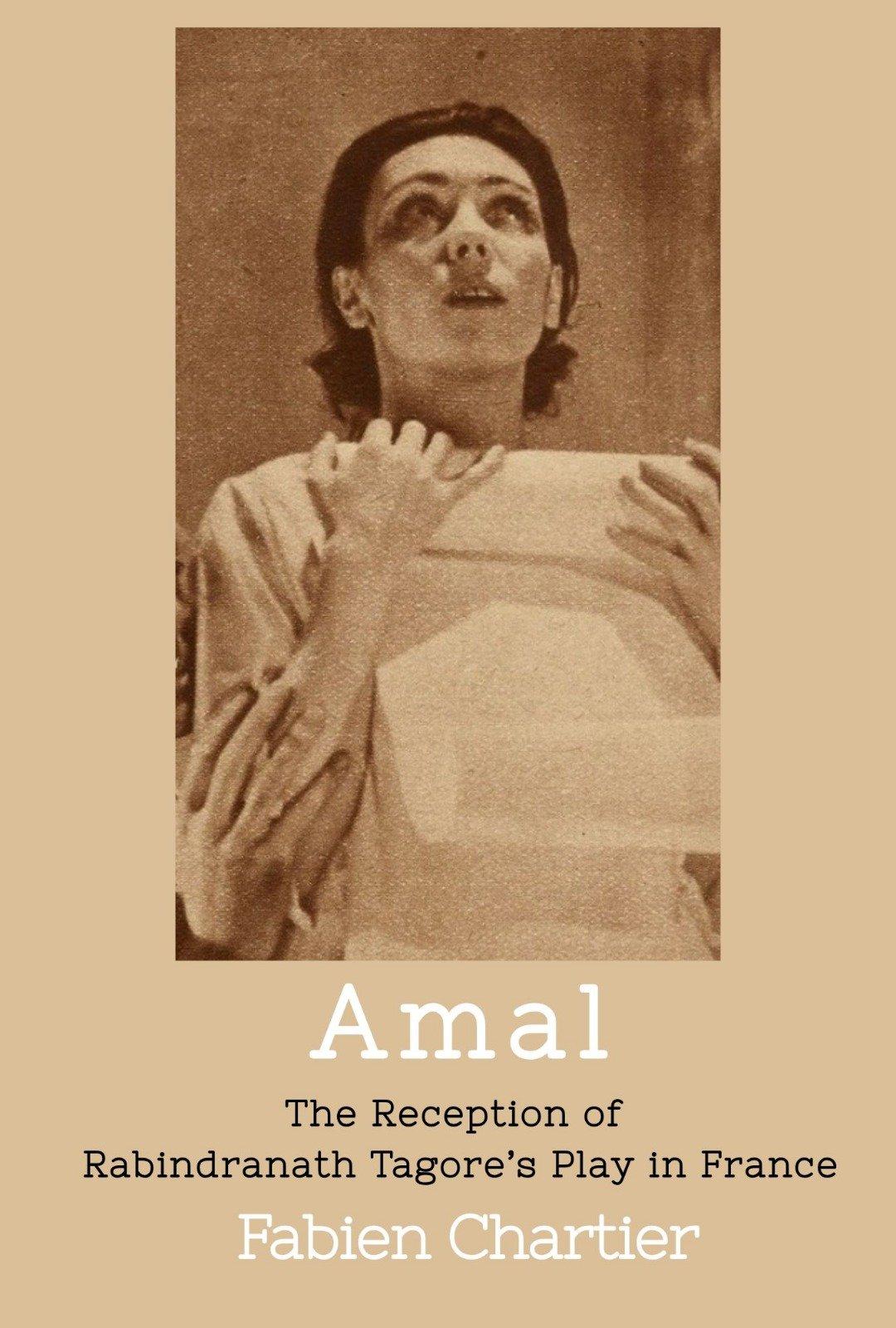
Amal: The Reception of Rabindranath Tagore's Play in France
The setting of Dakghar is confined to a single room opening onto a street. The action unfolds behind closed doors, yet symbolically opens outward through a window—ghare baire (“inside and outside”). Although Amal cannot cross this threshold, his gaze extends beyond it, while passersby glimpse, through him, an intimate, imagined world.
In France, translated from the English by André Gide and published in 1922 after years of delay, it met with a distinctive reception. Avant-garde directors—Jacques Copeau, Georges Pitoëff, Jean Marchat, Jean Dasté, and Pierre Valde—brought it to the stage, conveying a message of optimism: a lesson in living that led some to compare it to Le Petit Prince by Saint-Exupéry and La Mort du Dauphin by Alphonse Daudet. Journalists responded ambivalently, often reflecting their newspapers’ politics. Some saw Dakghar as deeply moving and spiritual; others missed its universality. Broadcast on radio, especially during the war, it reached a far broader audience. This essay accompanies a new French translation from the Bengali, published by Sampark Global.
Today, Dakghar retains its quiet force. Reading it—or seeing it on stage—reveals a work that still illuminates the fragile, hopeful dialogue between inner life and the world beyond.

Fabien Chartier
AuthorDr. Fabien Chartier is a lecturer in English, French, intercultural management, and geopolitics at the University of Rennes (Brittany, France). He wrote his Ph-D thesis on the reception of Tagore in France and Britain, and has published and edited numerous books and articles on Tagore and India. He has taught at Delhi University and St. Stephen’s College. A contributor to the National Library of France, Vice President of the Society for Research Activities on India (SARI), he leads writing and translation workshops in France and India. His forthcoming book will focus about Tagore and France.
Highlights
More like this
Sri Aurobindo, Global Tradition and Beyond
Sarani Ghosal Mondal, Goutam Ghosal
₹499.00
₹599.00
Revisiting Ancient Aesthetics: Poetry of Walt Whitman and Sri Aurobindo
Sarani Ghosal Mondal
₹499.00
₹599.00
Revolt of the Educated
Wolfgang Kraushaar
₹599.00

The Crisis of Modernity in Meiji Japan: A Critical Introduction to Kitamura Tōkoku and His Quest for Authenticity
Arpita Paul
₹499.00
₹599.00

France the Great Upheaval
Daniel Boeri
₹549.00
Follow us